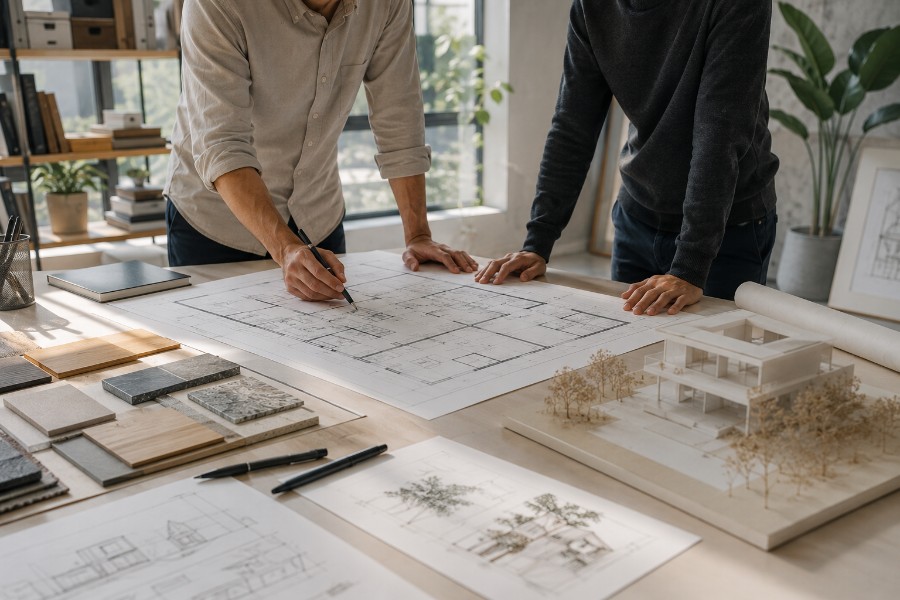
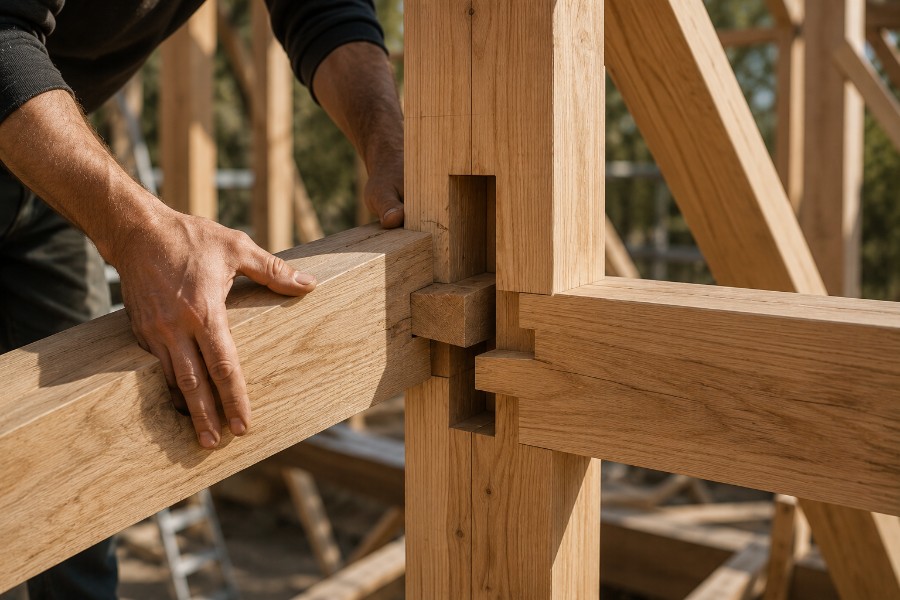
Most timber joinery today is cut by CNC machines, and for good reason — they’re precise, fast and consistent. But we still start every custom connection with a hand-drawn detail and, often, a physical mockup, before it ever reaches a machine.
What Gets Lost in a Rush to Digital
A joint drawn only in software can look perfect on screen and still fail in the hand — a reveal that’s technically correct but visually harsh, or a connection that’s structurally sound but awkward to actually build. Hand detailing forces us to think through how a joint will be assembled, not just how it will measure.
Mockups Before Commitments
For any connection that will be visible in a finished space, we build a physical sample before finalizing the drawing. It’s a slower step, but it catches problems — grain direction, tolerance, finish reaction — that are nearly impossible to predict from a drawing alone.
Machines Do the Execution, Not the Thinking
None of this is an argument against CNC fabrication, which we rely on for accuracy and repeatability. It’s an argument for keeping a human hand in the design decisions that precede it, so the machine is executing a considered idea rather than covering for one that was never fully worked out.